


Multi-stakeholder partnerships (MSPs) are an innovative form of cooperation that brings together various stakeholders to work towards common goals. This form of partnership-based collaboration is particularly well-suited to tackling complex challenges that require a range of perspectives. MSPs promote the exchange of knowledge and experience and pool resources. This can lead to sustainable solutions and provide added value for every stakeholder involved.
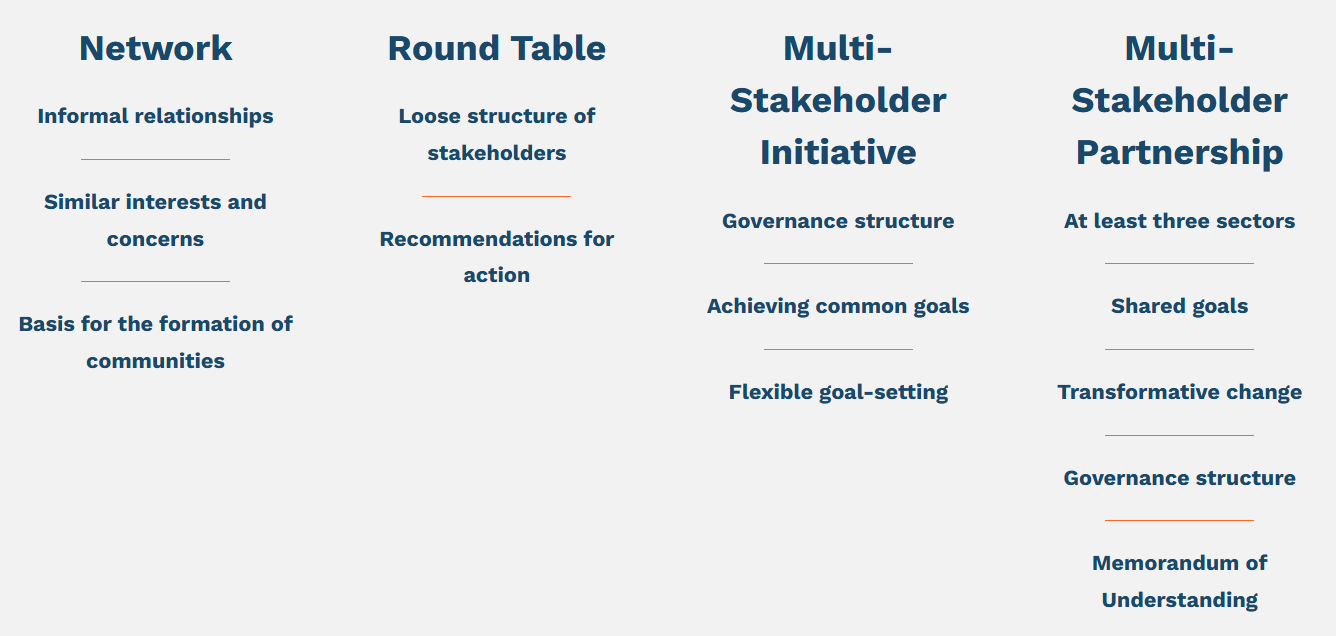
An MSP differs from other forms of partnership, such as a network or a round table, primarily through its commitment and joint implementation: at least three groups of stakeholders from different sectors (public sector, business, civil society and/or academia) work towards common goals over an extended period. They coordinate decisions, planning and activities amongst themselves and agree on their respective contributions and responsibilities. There are usually formal structures in place for this purpose, such as a steering committee, a secretariat or a Memorandum of Understanding. The goal is to work together to achieve meaningful results and contribute to transformative change at a systemic level.
Note: The boundaries between the various forms of partnership are often flexible; the diagram below illustrates the differences between them and may help with classification.
MSPs are crucial to the implementation of the 2030 Agenda, which encompasses the Sustainable Development Goals (SDGs). The specific contribution of an MSP depends on its focus and objectives. It may be directly linked to one or more of the 17 SDGs, for example climate action (SDG 13), gender equality (SDG 5) or decent work and economic growth (SDG 8). SDG 17, ‘Partnerships for the Goals’, also highlights the importance of this form of partnership. It recognises MSPs as a key mechanism for mobilising and sharing knowledge, expertise, technologies and financial resources. At the same time, MSPs can highlight the links between different SDGs.
On our website, you will find some examples and an overview of MSPs with German involvement.
Any stakeholder can initiate an MSP. The initiation phase may involve the following steps, which do not necessarily have to follow a fixed order in practice:
Check whether an MSP is the right format
Firstly, it should be clarified whether there is a fundamental interest amongst various stakeholders in tackling a particular challenge, and whether an MSP is suitable for this purpose. This also involves considering which partnerships and initiatives already exist and whether it is possible to build on them. In this way, duplicate structures and competition can be avoided.
Identify relevant stakeholders and build a core group
Initially engaged stakeholders can, for example, use a stakeholder analysis to identify, prioritise and approach other relevant actors from the business sector, public sector, civil society and academia. In doing so, a core group of stakeholders may already begin to form, consisting of those who are particularly keen to work together to drive the development of the MSP forward. Trust, transparency and a respectful approach are crucial from the very beginning. An MSP can start with just a few partners and take on further stakeholders later.
Develop a shared vision and objectives
During discussions or interviews with potential partners, the goal is to find out whether there is a shared understanding of the problem and the objectives. During this process, it should be clarified what an MSP is intended to achieve, what the respective added value for the various stakeholder groups is and what contribution each partner can make – for example, through expertise, networks, knowledge, time or financial and other resources. A solid foundation for further development is established when relevant stakeholders can agree on a shared objective, vision and initial key activities.
Clarify collaboration and initial structures
Then, potential work areas, roles, responsibilities and decision-making processes should be defined in concrete terms. Clear lines of communication, milestones and interim targets, as well as a shared approach to managing expectations, are helpful. The scope of action and work should initially be kept as small and specific as possible. The individual ‘red lines’ of the stakeholders involved should also be made transparent and considered.
Move towards collaborative design
Once the objectives and roles of the stakeholders involved have been clarified and initial agreements have been reached, an MSP can move on to the next phase. At this stage, success indicators, working methods and management, decision-making and communication processes are defined in more detailed terms. The agreements can, for example, be set out in a Memorandum of Understanding. The entire process requires time, resources, trust and a willingness to regularly reflect on the collaboration in a self-critical manner. It is crucial that the various stakeholders take joint responsibility and that the structures and approach enable collaboration on an equal footing.
Our practical guide on this topic provides a detailed overview of the first steps, practical advice and further tools. Partnerships2030 can advise and support you in developing your MSP.
There is no fixed or generally applicable duration for an MSP. An MSP typically develops through several phases: initiation, design, implementation and further development. These phases flow into one another and may vary in duration depending on the situation. Individual phases may also be repeated if the circumstances change or if the strategy needs to be adapted. What matters, therefore, is not so much a specific duration as whether an MSP can continue to contribute to the achievement of shared objectives.
Once the shared objectives have been achieved, the MSP can be further developed or ended. It is important to document the experiences and results and make them accessible to other stakeholders. Maintaining an MSP is expressly not an end in itself.
In summary, MSPs do not have a strictly defined lifespan; they continue to exist for as long as the joint collaboration remains meaningful and effective.
Read more:
Phases of MSPs
Transformation of MSPs
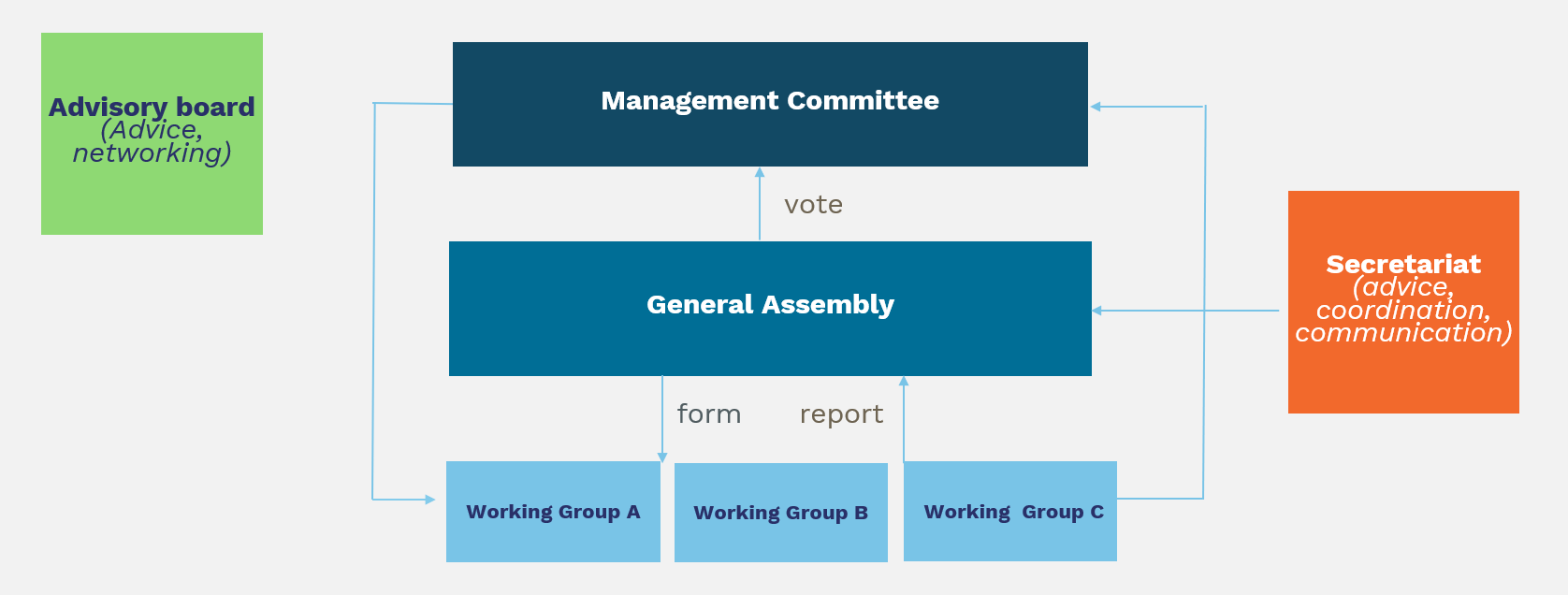
Different MSPs have different organisational structures. The appropriate governance structure depends on factors such as the number and composition of the stakeholders involved, the objectives and activities, the context, the legal form and the funding. Generally speaking: as complex as necessary, as simple as possible.
Typically, the governance structure consists of several elements:
General Assembly: Usually includes all members of the MSP and serves as a forum for exchange and joint decision-making. It may, for example, elect the steering committee and issue strategic mandates.
Steering Committee or Management Committee: Responsible for the strategic management of the MSP and is often composed of equal numbers of representatives from the various stakeholder groups. Its tasks include, in particular, making strategic decisions and defining the decision-making process.
Secretariat: Provides organisational and administrative support to the MSP, oversees processes and prepares meetings and decisions. In smaller MSPs, this role may also be undertaken by one or more partners.
Working groups: Can be set up to address specific topics, prepare or implement activities or provide content-related support to the steering committee.
Advisory Board or Sounding Board: Can be established to provide additional expertise, external perspectives and critical reflection (when necessary).
Example of an organisational structure of an MSP:
A detailed overview of MSP’s governance structures, their functions, typical bodies and success factors can be found in the publication on governance structures in MSPs.
A successful MSP requires a shared direction, committed collaboration and appropriate structures. It is crucial that the stakeholders involved agree on common goals and a clear vision and nurture these over time. At the same time, the respective interests of the stakeholders and the individual added value of the collaboration can be maintained. Just as important are the equal sharing of responsibility, clear roles and transparent decision-making processes.
To ensure that the collaboration works in the long term, all relevant stakeholders should be involved and work together on an equal footing. Fundamental trust, a common ‘language’ and a constructive approach to communication form an important basis for this. A neutral secretariat with adequate resources can support coordination and process management and help drive the achievement of objectives.
Furthermore, an MSP requires sufficient human and financial resources overall, as well as a clear focus on concrete results. Regular monitoring, evaluation and collaborative learning help to further develop the partnership and respond to changing circumstances. Transparent communication of experiences and results also strengthens the partnership’s legitimacy and support.
Finally, an MSP should remain mindful of its social and political context, consider relevant developments and existing initiatives and network with other partnerships and stakeholders. In this way, it can learn from experience, capitalise on synergies and increase its long-term impact.
Read more:
Success factors for MSPs
A few examples:
Five Years of Generation Equality: New Publications and a Vision for 2030
Strengthening Multi-Stakeholder Collaboration for Land Governance in Sierra Leone
MSPs bring together a wide range of different organisations and perspectives, which can pose certain challenges. Here are a few examples:
Challenge: Different stakeholders bring different values and expectations to the partnership, which can lead to misunderstandings or conflicts.
Possible solution: To establish a common understanding, an event could be organised at the start of the partnership in which all stakeholders outline their respective interests and underlying values. This process would foster the development of a shared vision and help to create transparency regarding different perspectives.
Challenge: The large number of stakeholders can slow down decision-making processes and make them complicated.
Possible solution: The introduction of a steering group comprising representatives from all stakeholder groups involved could speed up decision-making. Regular communication and transparent documentation of decisions are also essential to keep all stakeholders informed.
Challenge: Legal uncertainties can slow down the progress of an MSP.
Possible solution: Early legal support could help to identify and address potential problems.
Challenge: An unstable financial foundation can threaten the sustainability of the partnership.
Possible solution: Developing sustainable and diversified funding models is crucial. This could take various forms, such as introducing membership fees, involving additional donors or developing the organisation’s own sources of income.
By addressing each challenge in a targeted and structured way with practical solutions and examples, MSPs can be designed more effectively and the chances of sustainable success can be increased.
MSPs measure their impact not only based on their activities and immediate outcomes, but also in terms of the contribution that collaboration between the various stakeholders makes towards the desired changes and the added value of the partnership itself.
A helpful approach to measuring impact can be the joint development of an impact narrative. It describes and visualises how an MSP uses its resources to work towards the desired impact. This involves examining the impact pathway – from inputs through activities and outcomes to long-term impact – as well as the various levels of impact and the areas of control, influence and interest. On this basis, MSPs can define suitable indicators for measuring impact and review them regularly. In addition to thematic impacts, changes at the partnership level can also be recorded, e.g. the understanding and relationships between members, as well as their sense of ownership and commitment. Depending on the objective and context, various methods are suitable for data collection, e.g. surveys, interviews or the recording of so-called ‘impact stories’. It is important to subsequently reflect on the results together and use them to further develop the MSP.
Further information and practical resources on the effects of MSPs can be found on our website. Find out how the impact narrative was applied in the development of the Theory of Change by the Gender & Chemicals Partnership.
MSPs can promote gender equality by systematically incorporating the experiences and perspectives of women and other rights-holders, particularly marginalised or discriminated-against individuals, and by considering power dynamics within the partnership and in their thematic area. To this end, they should analyse gender-specific impacts from the beginning, involve affected groups and gender experts and set out specific objectives and measures.
Gender equality should not be treated as a stand-alone project, but rather integrated as a cross-cutting issue – within the MSPs’ activities, decision-making structures and working processes. Regular monitoring using appropriate indicators, sufficient resources and joint reflection help to assess progress and further develop measures. In this way, MSPs can contribute to fairer and more effective solutions and avoid the risks that arise when different needs and life realities are not considered.
Read more:
Gender equality in MSPs
Further questions? We’re here to help!
Do you have a question that isn’t answered on our website or do you need specific support for your MSP? If so, please feel free to contact Partnerships2030. We provide support and advice to MSPs on all aspects of their design, implementation and further development.
Partnerships2030-Secretariat
Deutsche Gesellschaft für
Internationale Zusammenarbeit (GIZ) GmbH
Friedrich-Ebert-Allee 32
53113 Bonn
Germany
info@partnerships2030.org
+49 228 4460-3539